
Davis County Records Access
In Davis County, Utah law does not make every government file open in the same way. The record type, its custodian, and its classification control access. Davis County public records include land instruments, parcel data, open court dockets, some marriage material, and current jail-roster entries. A free index may confirm that a record exists while the image, full file, or certified copy must come from the office that keeps it.
| Record Series | Office That Keeps It | Web Coverage | Practical Access |
|---|---|---|---|
| Deeds, mortgages, liens, plats | Davis County Recorder | Free parcel context; REDI about 1983 to present | Paid REDI abstracts/images, free terminal, counter or mail copies |
| Property value and taxes | Assessor and Treasurer | Shared Property Search | Free informational view; call the responsible office for corrections |
| Civil, criminal, probate, divorce | Second District and justice court clerks | XChange, district data broadly complete from late 1998 | Paid web access, free courthouse terminal, clerk copies |
| Birth, death, marriage, divorce abstracts | County Health, Clerk, state Vital Records, courts | Forms and limited historical indexes | Recent copies require identity and eligibility |
| Current county custody | Davis County Sheriff | Current inmate roster | Free roster; agency request for other releasable records |
| Other county administration | Department retaining the record | NextRequest when not already published | GRAMA request; actual fulfillment costs may apply |
Recent Davis County certificates, protected voter details, sealed or expunged cases, adoption and juvenile material, protected military discharge content, and motor-vehicle personal data do not become open through a broad request. Utah GRAMA classifies records as public, private, controlled, or protected. It also requires agencies to separate and release an open portion when the law allows redaction of the rest.
Davis County Public Records Desks
Farmington is the Davis County records hub, but the custodians remain distinct. The Recorder, Clerk, Assessor, and Treasurer work from the county administration complex. Davis County Health issues vital certificates from Clearfield. Courts retain their own case files, so a county GRAMA submission is not a substitute for asking the correct court clerk.
Davis County Recorder
Suite 106, 61 S Main, Farmington, UT 84025
801-451-3225, Monday-Friday 8-5
Davis County Health Vital Records
22 S State St, Clearfield, UT 84015
801-525-5150, Monday-Friday 8-5
The county records-request instructions show which common files belong elsewhere. The captured routing screen makes that department check visible before a request is filed.
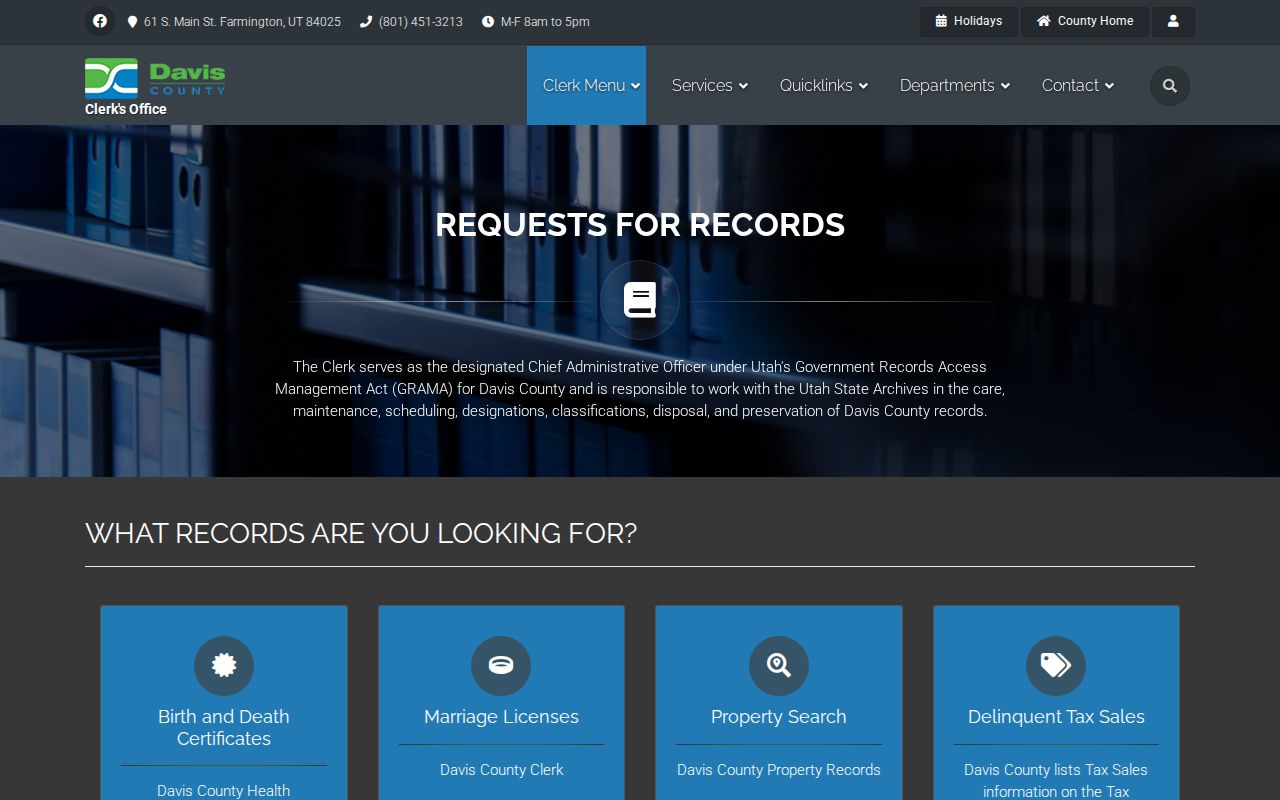
Using that route first avoids sending birth, marriage, tax, court, or criminal-history requests to a coordinator who does not retain them.
Davis County Recorder Record Eras
The Davis County Recorder describes a long but layered collection. County stewardship dates to 1850. Historical books are described from 1870, computerization and microfilming began in 1981, and searchable REDI documents reach back about 1983. That sequence matters because an empty online result may mean the deed is in an older book, not that no instrument exists.
The Davis County Recorder office page connects the modern tools with counter help and copy services. The captured interface shows the official starting point for recorded land material.
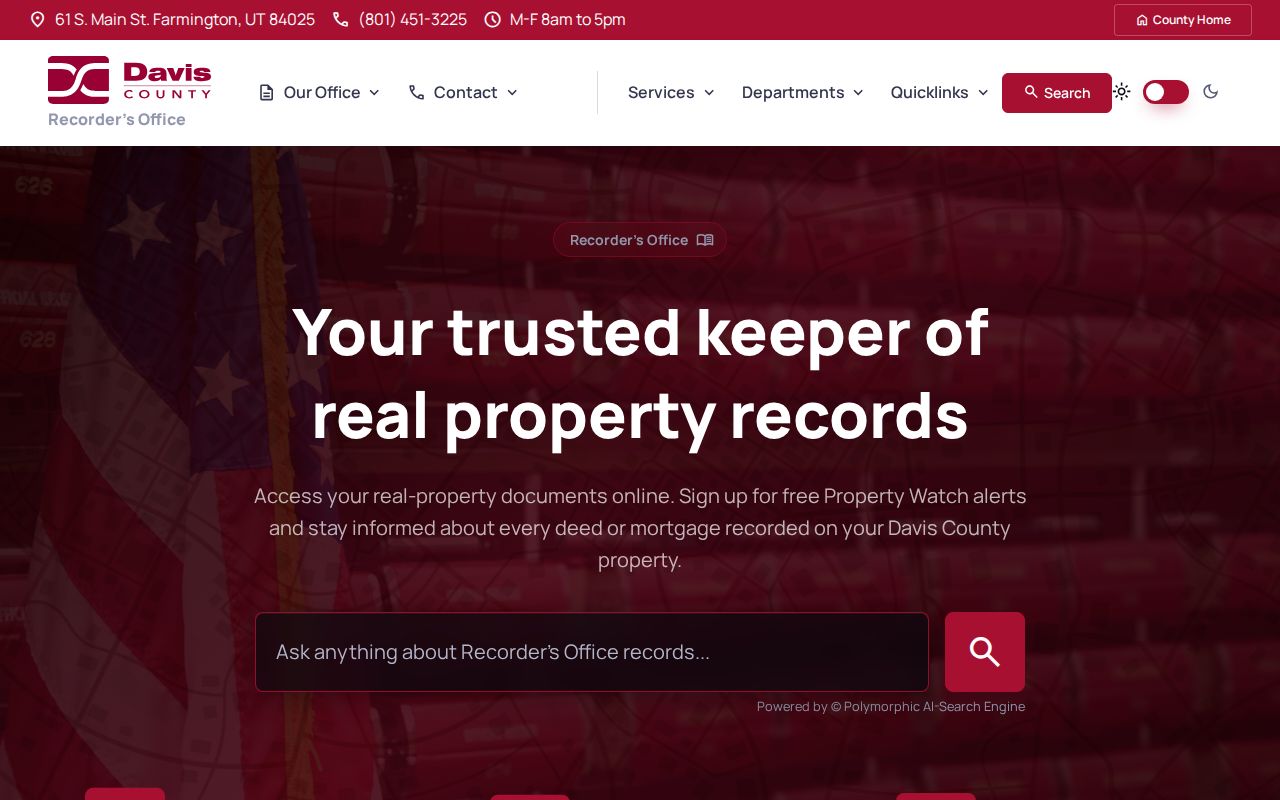
For pre-REDI work, use the public terminal and ask staff to locate the right book or ownership plat. Staff can help find records, but the office does not conduct a title search or give legal advice. Mailed copy orders are described as taking about five to ten business days, and the Recorder states that it does not accept phone-in orders.
Note: A missing REDI hit can be a coverage boundary; older Davis County instruments remain an office-book search.
Davis County REDI Record Fields
Davis County REDI-Web is the document-depth tool. It offers a level without images for document information and a level with scans. Searches may incur a charge even when they produce no result, so start with the free Property Search to resolve the parcel serial. Then use that serial in REDI. Official materials conflict on some usage prices; verify the current contract rather than relying on an old help-guide amount.
| Search Field or Mode | Input | When It Helps | Format Note |
|---|---|---|---|
| Entry Number | Text | Direct recorded instrument | Use when a citation is already known |
| Party Name | Text | Owner, grantor, or grantee trail | Try spelling and initial variants |
| Book and Page | Text pair | Legacy citation | Useful for older references |
| Development | Text/search | Subdivision or development | Mode dependent |
| Serial or Parcel Number | Text | Exact parcel trail | Best resolved in free Property Search |
| Owner Name | Text | Properties tied to a name | Separate same-named owners with other facts |
| Situs Address | Text | Physical parcel address | Omit a suffix or direction if needed |
- Index
- A finding aid that points to a record; it is not the complete instrument.
- Image
- A scan of the filed document, available under the applicable portal level or from the office.
- Certified copy
- A custodian-issued copy bearing official certification for uses that require proof of authenticity.
- Custodian
- The office that retains and controls access to the record.
- Exemption
- A law-based reason to withhold or redact material that is not public.
These terms explain why a name hit, a document scan, and a certified instrument can answer three different needs. Ask the Recorder which form is required before ordering.
Davis County Property Record Split
The Davis County shared map does not erase the split in responsibility. The Recorder answers ownership, address, and legal-description questions. The Assessor handles value and property characteristics. The Treasurer handles taxes. Property Search accepts an address or parcel ID, uses autocomplete, and opens parcel detail from the map. It may show owner information, serial, legal description, boundaries, values, classification, tax links, recorded-document links, and a mailing address.
Do not treat a tax mailing address as proof that the named owner lives at the parcel. The data can also lag by at least a day. The GIS portal adds zoning, flood, aerial, and jurisdiction layers, but those layers show land context, not who occupies it. If a parcel crosses a jurisdiction question, confirm the municipality before seeking a permit or city file.
The useful distinction is simple: free map information is for discovery, a REDI image shows the filed instrument, and an official certified copy comes from the Recorder. That split keeps a quick web result from being mistaken for final legal proof.
Davis County Court Record Channels
For Davis County cases, Utah XChange holds statewide party and case summaries. Most district-court data is broadly complete from late 1998, while justice-court start dates vary. A public docket can show case number, court, case type, parties and roles, filing date, events, judge, and disposition or status. Some district documents filed since 2010 may be bought online when their classification permits release.
Online XChange access costs money, but public terminals at most district courthouses and the Utah State Law Library are free. The local clerk supplies certified copies, archived files, and answers about a case the index cannot resolve. Paper court copies are 25 cents per sheet; electronic media or a half day of audio or video is $15. The first 15 minutes of staff time are free, followed by published role-based charges.
There is no alternate door into sealed, expunged, juvenile, adoption, or other private court content. For probate, open orders and letters of appointment can document a personal representative or heir trail, while private filings remain unavailable.
Note: A docket address dates to the filing and should never be treated as proof of current residence.
Davis County Vital Record Limits
Davis County birth, death, marriage, and divorce records follow different custody and access rules. Under Utah Code §26B-8-125, birth certificates become public after 100 years, death certificates after 50 years, and marriage or divorce records after 75 years. Recent certificates require the subject, qualifying immediate family, guardian, or a designated legal representative to show identity and the required relationship or authority.
The county Vital Records service page explains the local in-person and mail route. The captured county screen shows where Davis County residents check eligibility, identity, and application requirements.
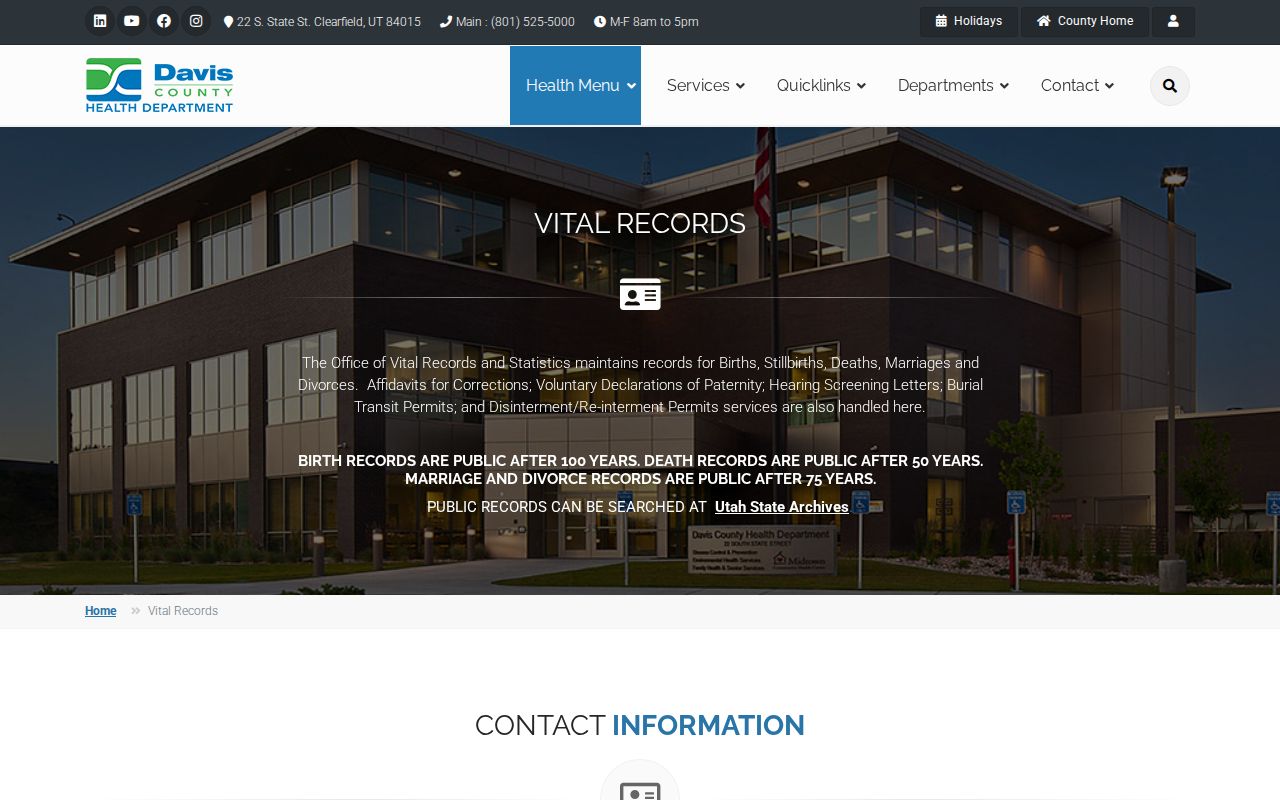
Davis County Health issues Utah birth and death certificates plus marriage and divorce abstracts for 1978 through 2010. A county marriage license or certified marriage record comes from the Clerk, while a full divorce decree comes from the district court.
Davis County Certificate Costs
For Davis County orders, the state fee schedule changed on July 1, 2026. A first birth certificate or marriage or divorce abstract costs $25. A first death certificate costs $35. Each additional copy of the same record costs $10. Online, card, identity, or shipping charges may also apply. A no-record search still uses the certificate fee, so check the event place, year, and correct custodian before paying.
The state reported a roughly six-week online and mail backlog in June 2026. Complete local in-person requests may be printed the same day, subject to workload and the Davis office cutoff. The Utah vital-record forms collection is pictured here and supplies the official applications.
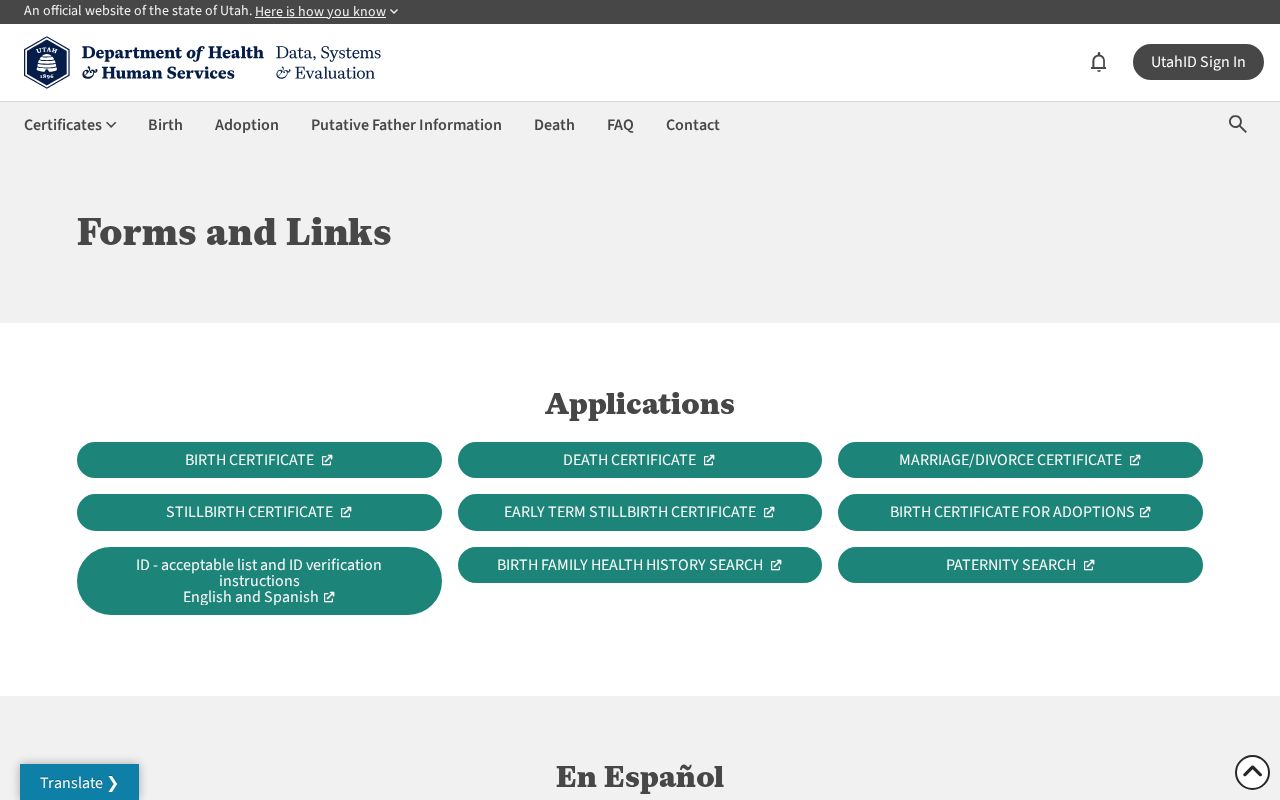
Mail applications need readable identification copies, payment, the event details, requester relationship, and any proof that links the requester to the subject. An incomplete application can be delayed or returned.
Davis County Custody Records
The Davis County Sheriff inmate roster is a free, current-custody tool. Search by name. The table exposes booking date, first and last name, gender, age, and a details link, with pagination and a page timestamp. Exact release dates and times are intentionally withheld for safety. A failed roster search does not show that someone has no criminal or court history.
The Utah Department of Corrections Offender Search covers Davis County people under state custody or supervision. It does not cover all county pretrial or unsentenced detainees. Police and crash reports must go to the law-enforcement agency that holds them, and privacy or active-case rules may require redaction.
Lawful personal use. Open access never permits stalking, harassment, threats, or intimidation. Utah law can punish misuse even when the source record was public.
Request Davis County Public Records
For Davis County agencies, GRAMA applies to an existing record retained by a government entity. Utah Code §63G-2-204 requires the requester’s name and contact details plus a reasonably specific description. The request cannot force an office to answer questions, build a new report, combine databases, or search for everything about a person. Name the record series, date range, case or entry number, address, and desired public portion when those facts are known.
- Identify the custodian. Use the county routing page first. Go directly to the Recorder, court clerk, Vital Records, or another keeper when it has a normal copy channel.
- Check published access. Search the official index or use a free terminal when it can locate the record and cut staff time.
- Describe an existing record. Give a focused series, subject, date span, and known identifier. Ask for electronic delivery if that form works.
- Submit through the right route. Other county administrative requests can use NextRequest, GRAMA@DavisCountyUtah.gov, or the Records Manager.
- Review cost and scope. Narrow an overbroad request if needed. Pay any lawful copy, certification, or actual fulfillment charge.
The Davis County NextRequest portal is the online fallback for county material that is not already published or supplied through a department’s routine process.
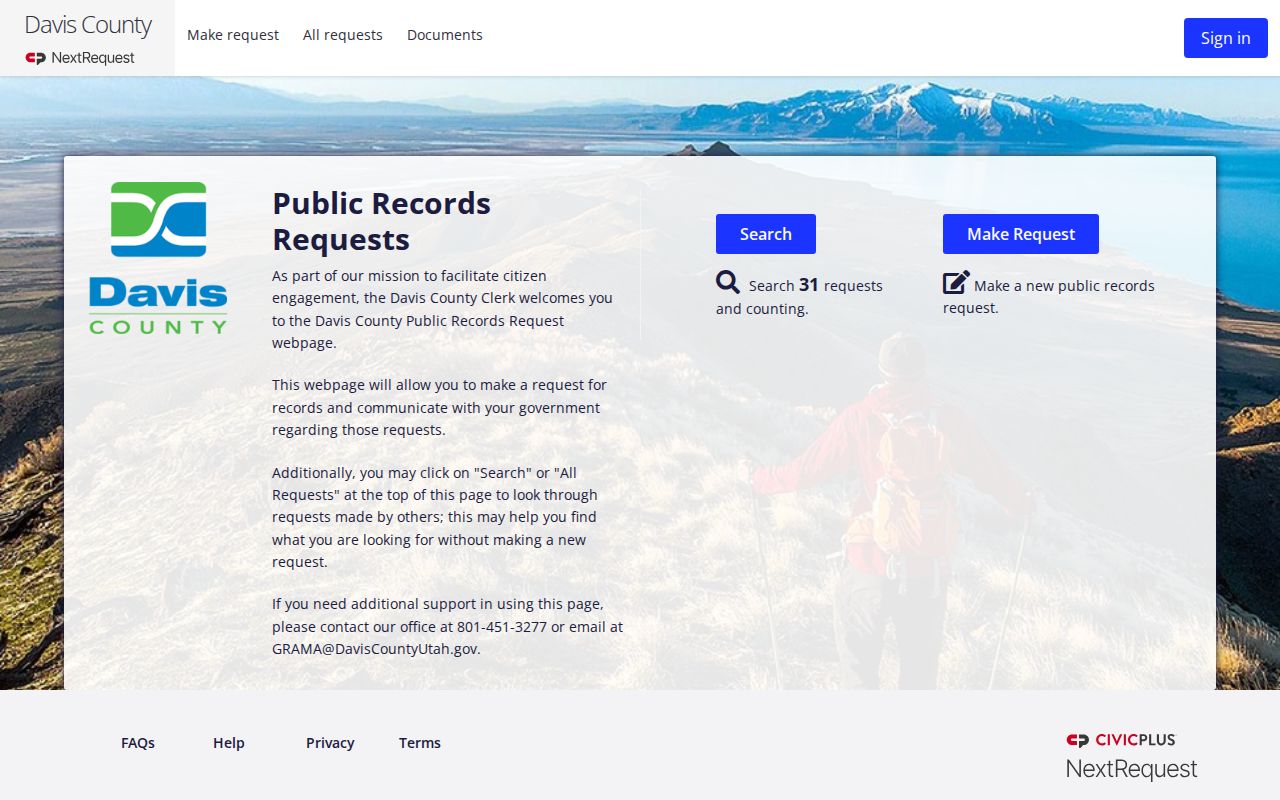
The portal submits the request; it does not change the record’s classification, force creation of an answer, or replace a court and vital-record request path.
Davis County GRAMA Timing
The ordinary Davis County response period is ten business days. A supported expedited request that benefits the public rather than only the requester uses five business days. Extraordinary circumstances may allow the entity to give an estimated response date. If no record or denial arrives within the statutory time, GRAMA treats the silence as a denial.
Fees must reflect reasonable actual cost under §63G-2-203. Staff research is generally charged at the rate of the lowest-paid qualified worker, and the first 15 minutes are ordinarily free. Inspection of open records is free. Prepayment may be required when estimated fees exceed $50 or the requester has unpaid prior charges. A waiver may apply when disclosure chiefly benefits the public, the requester is the record subject, or legal-rights and hardship grounds support it.
The Utah GRAMA process FAQ provides state guidance on requests, denials, and review. Its captured page is a useful check when a Davis County response cites a GRAMA classification.
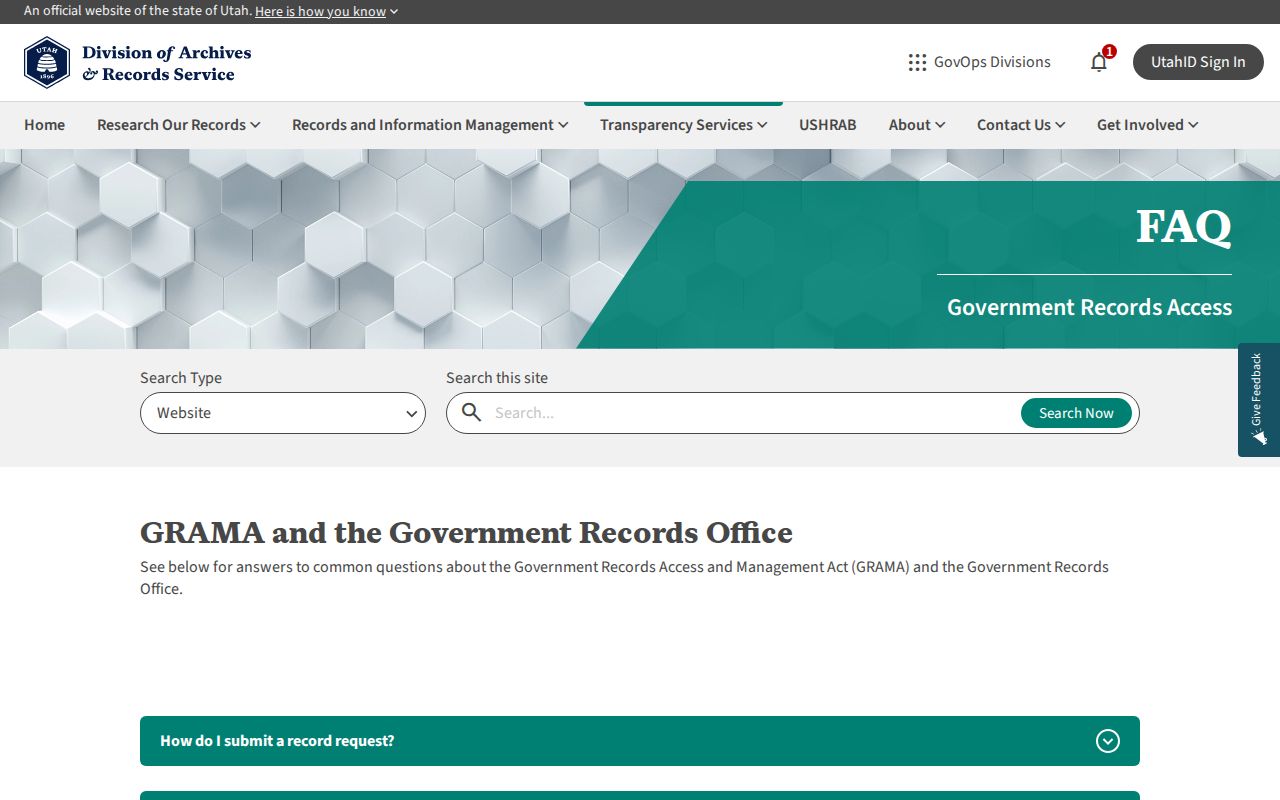
A denial must identify the withheld material, cite its legal basis, and explain the appeal route. That written reasoning is the key document for the next step.
Appeal a Davis County Denial
A Davis County requester generally has 30 days to appeal a denial to the entity’s chief administrative officer under Utah Code §63G-2-401. The next route may involve the Government Records Office, mediation, the State Records Committee, district court, or the local process that applies to that body. Follow the appeal instructions in the denial because the proper forum and deadline can depend on the custodian.
Keep the original request, submission receipt, fee correspondence, response, cited statute, and any redacted copy. A focused appeal can challenge the classification, ask for segregation of open portions, or dispute an unsupported fee. It should not ask the reviewer to create a person report the office never maintained.
Note: Certified proof and web discovery are different products; request certification only from the office that keeps the source record.